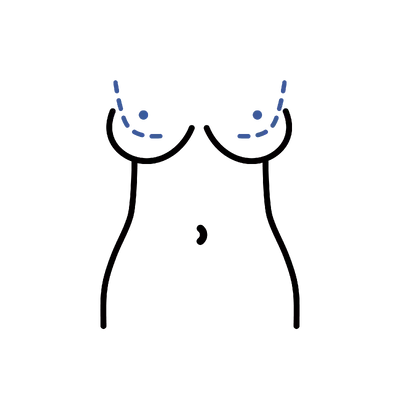
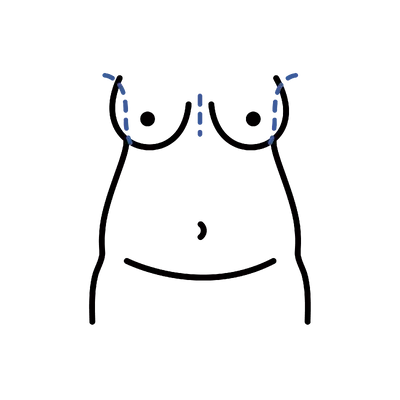
If your chest is on the smaller side — typically an A or B cup — periareolar top surgery can create a flat, masculine contour through a single incision hidden around the areola. You get chest masculinization with minimal visible scarring, avoiding the longer incision lines of double incision techniques, while preserving nipple sensation in most cases.
Request a Free Quote
Receive Your Plan
We Handle the Rest
Request a Free Quote
Receive Your Plan
We Handle the Rest
Free, no-obligation — you pay the hospital directly with no markup.
What Is Periareolar Top Surgery?
Periareolar top surgery removes breast tissue through a circular incision around the edge of the areola, resulting in a flat masculine chest with scarring confined to the areolar border. The approach relies on skin retraction to lie flat over the chest wall, so it works best for patients with smaller chests (generally A to small B cup), good skin elasticity, and minimal skin excess. The areola can be reduced in diameter during the same procedure.
Unlike double incision, periareolar surgery preserves the nipple on its native blood supply and nerve connections, meaning sensation is more likely to be retained. However, patients with larger chests, significant ptosis, or poor skin elasticity may not achieve a satisfactory result with this technique. Your surgeon will be direct about whether a different approach would serve you better.
Common Concerns Periareolar Top Surgery Can Address
- Chest dysphoria despite having a smaller chest size
- Desire for chest masculinization with minimal visible scarring
- Discomfort or restriction from binding a smaller chest
- Wish to retain nipple sensation where possible
Are You a Good Candidate?
- Smaller chest, typically A to small B cup
- Good skin elasticity with minimal excess or sagging
- A referral letter from a qualified mental health professional
Why Choose Thailand for Periareolar Top Surgery?
Thailand's gender-affirming surgeons see enough case volume to have strong judgment about which patients will do well with periareolar surgery and which need a different approach. That honest assessment is worth more than a clinic that will tell you what you want to hear.
High Volume
Case Frequency Builds Judgment
Periareolar candidacy assessment is where experience matters most. Our surgeons see enough cases to be direct about who will and will not get a flat result.
40–60%
Significant Cost Savings
Same surgical standards and accreditation as international hospitals, at a fraction of the cost. You pay the hospital directly — no markup from us.
Weeks
No Gatekeeping Delays
Once your documentation is complete, surgery scheduling moves fast. No multi-year waiting lists or referral bottlenecks common in public health systems.
Global
Set Up for Overseas Patients
English-speaking teams, dedicated coordination, and a recovery infrastructure designed specifically for international medical travellers.
Periareolar Top Surgery Cost in Thailand
We do not charge for our service — you pay the hospital directly with no markup. Here is what periareolar top surgery typically costs and how it compares to home.
🇹🇭 Thailand
$3,000 – $6,600 (฿105,000–฿231,000)
🇺🇸 United States
$9,000 – $16,500
🇦🇺 Australia
A$8,400 – A$15,000
🇬🇧 United Kingdom
£7,500 – £13,500
Your Quote Will Include
- Board-certified surgeon fee
- Anaesthesia & operating theatre
- Hospital stay & nursing care
- Post-operative medications
- Follow-up appointments
- Dedicated care coordinator
Prices are approximate and vary by technique, surgeon, and hospital. Your personalised quote will include a full cost breakdown.
Our service is free — you pay the hospital directly with no markup or hidden fees.
Get Your Free Quote
24hr Response
No Obligation
Care Coordinator
Average Cost of Periareolar Top Surgery in Thailand
Periareolar top surgery in Thailand typically costs between $3,000 and $5,400. The range depends on surgeon experience, hospital accreditation level, and whether an extended technique with lateral excision is needed. Straightforward concentric cases sit at the lower end.
Cost Breakdown
The surgeon's fee is the largest component, reflecting the technical precision required. Hospital and theatre fees cover the facility, operating room, and nursing. Anaesthesia fees cover the anaesthetist and intra-operative monitoring. Aftercare includes compression vest, medications, and follow-up visits.
What Affects the Price?
The main price variable is surgical complexity. Standard periareolar on an A cup is the most straightforward case. Extended techniques on borderline candidates take longer and cost more. Revision cases where a prior periareolar result was inadequate also carry a higher fee. Hospital tier and surgeon experience influence the total.
Cost by Periareolar Top Surgery Type
Pricing varies by the complexity and scope of the procedure. Typical ranges at our partner hospitals in Thailand:
- Periareolar mastectomy (standard): $3,000–$3,800 — suitable for smaller chest sizes with good skin elasticity
- Periareolar with liposuction-assisted reduction: $3,600–$4,500 — liposuction used alongside excision for better contouring
- Periareolar with nipple resizing and repositioning: $4,200–$5,400 — includes adjustment of nipple diameter and placement for a masculine result
Exact pricing is confirmed after your consultation and treatment plan are finalised.
Thailand vs International Price Comparison
Periareolar top surgery in Thailand costs 40–60% less than equivalent procedures in the US ($9,000–$16,500), Australia (A$8,400–A$15,000), and UK (£7,500–£13,500). The saving comes from lower operating costs in Thailand, not from reduced surgical standards. Our partner hospitals are JCI-accredited.
Types of Periareolar Top Surgery in Thailand
Periareolar surgery has two main variations. The choice between them depends on how much tissue and skin needs to be removed, and whether you sit at the upper limit of periareolar candidacy.
Standard Periareolar (Concentric Circular)
Two concentric circular incisions — one around the areolar border, a larger one surrounding it. Breast tissue is removed through the doughnut-shaped opening, and the outer skin edge is gathered with a purse-string closure. This tightens the skin and reduces the areola in a single step.
- Scarring limited to the areolar border
- Areola can be resized and reshaped simultaneously
- Nipple remains on its pedicle, preserving blood supply and sensation
- Best for: A cup chests with good skin elasticity
Extended Periareolar (Keyhole Variant)
Uses a slightly larger outer incision to accommodate more tissue removal in patients at the upper limit of periareolar candidacy. A small lateral skin wedge may be excised to improve contour. This balances minimal scarring with the need for additional skin removal.
- Addresses chests between periareolar and double incision criteria
- Still avoids the long horizontal chest scars of double incision
- Allows more tissue removal than the standard concentric approach
- Best for: small B cup, or borderline cases with minor skin laxity
Periareolar Top Surgery Techniques Used in Thailand
Both variations centre on a concentric incision approach, but they differ in how much tissue and skin can be removed. Your surgeon will assess chest size, skin quality, and nipple-areolar dimensions to determine which delivers the flattest result with the best scar outcome.
Concentric Circular Technique
The standard periareolar method. Two circular incisions create a doughnut-shaped opening for tissue removal. The outer skin is gathered and sutured to the areolar margin. Skin contracts over the following months to smooth out any initial puckering.
- Single-step tissue removal, skin tightening, and areola reduction
- Nipple stays on its pedicle with full nerve and blood supply intact
- Initial puckering resolves as the skin settles over weeks to months
- Best for: patients with A cup chests and excellent skin retraction
Extended Keyhole with Lateral Excision
Adds a small lateral wedge of skin excision to the concentric technique. This allows more tissue and skin to be removed for patients at the upper boundary of periareolar candidacy. The additional scar is small and positioned laterally where it is less visible.
- Accommodates slightly larger tissue volumes than standard periareolar
- Small additional lateral scar trades off against a flatter result
- Preserves nipple pedicle and sensation like standard periareolar
- Best for: small B cup or patients with moderate skin laxity
Periareolar Top Surgery Recovery Timeline (Thailand)
Days 1–3
Mild to moderate soreness and swelling around the chest, well controlled with prescribed pain medication. You wear a compression vest to support healing. Light walking is encouraged, and your care coordinator checks in daily.
Weeks 1–2
Swelling and bruising gradually subside. Temporary puckering around the areola from the purse-string closure is normal and smooths out as healing progresses. A follow-up appointment checks wound healing and suture status.
Weeks 3–4
Comfort and mobility continue to improve. Most patients can resume desk work and gentle exercise. The compression vest is worn for four to six weeks total. Avoid heavy lifting and chest-level exertion.
Months 2–6
The areolar scar matures and blends with surrounding skin. Any residual puckering or irregularity continues to settle. Full exercise and activity restart after surgical clearance. Most patients see their settled chest contour by three to six months.
Permanent
Flat chest with minimal scarring
Hidden Scars
Incision concealed at the areolar border
Sensation Retained
Nipple feeling preserved in most cases
When Can You Fly After Periareolar Top Surgery?
Most patients can fly home 10–14 days after surgery. By that point the immediate swelling has settled, your surgeon has checked healing at a follow-up, and any initial wound concerns have been addressed. Wearing a compression vest during the flight is recommended. Mild swelling from cabin pressure and immobility is temporary.
When Can You Return to Work and Exercise?
Desk work can resume at two to three weeks. Light walking is encouraged from day one. Gym workouts and upper-body exercise should wait until six weeks. Swimming needs the same clearance. Your surgeon provides guidance based on your specific healing progress.
When Will You See Final Results?
The chest is visibly flat once the compression vest comes off, but initial puckering from the purse-string closure takes weeks to months to smooth out. By three months the contour is close to final. Areolar scars continue to mature and blend for up to 12 months.
Risks and Safety of Periareolar Top Surgery
Periareolar surgery has a good safety profile when performed on appropriately selected patients. Patient selection is the single most important factor in achieving a satisfactory result.
- Residual breast tissue or inadequate flattening requiring revision
- Skin puckering or contour irregularity around the areola
- Areolar stretching or widening over time
- Temporary or permanent changes in nipple sensation
- Haematoma or seroma formation
- Infection or delayed wound healing (uncommon)
The most common issue is residual tissue or skin laxity that prevents a completely flat result. This is why patient selection is critical — and why an honest assessment during consultation matters more than a surgeon who agrees to periareolar surgery on every chest.
Is Periareolar Top Surgery Safe in Thailand?
Yes. Performed at a JCI-accredited hospital by a board-certified gender-affirming surgeon, periareolar top surgery in Thailand is as safe as anywhere in the world. The key safety factor is patient selection — the procedure itself is straightforward when it is performed on the right anatomy.
How to Reduce Risks
Start with an honest assessment of whether your chest is actually suitable for periareolar surgery. If your surgeon recommends double incision instead, that is valuable advice, not a sales pitch. Follow compression garment instructions, avoid upper-body strain, and attend all follow-ups. If puckering or contour concerns develop, communicate early.
When Is Revision Needed?
Revision may be needed if the result is not flat enough due to residual tissue, skin laxity, or areolar stretching. A small percentage of periareolar cases require conversion to double incision if skin retraction is insufficient. This possibility is discussed during consultation so you can factor it into your decision.
Top Periareolar Top Surgery Surgeons & Clinics in Thailand
The surgeon's judgment about candidacy is as important as their technical skill. Here is what to look for.
Leading Hospitals in Bangkok
Our partner hospitals are JCI-accredited with dedicated gender-affirming surgery departments. Periareolar top surgery is a routine procedure at these centres. Full hospital infrastructure means complications, if they occur, are handled in-house with immediate access to the surgical team.
Experienced Periareolar Surgeons
Our partner surgeons are board-certified by the Thai Board of Plastic and Reconstructive Surgery and have significant experience with periareolar top surgery specifically. They see enough cases to have clear criteria for who is a good candidate and who should be directed toward double incision for a better outcome.
What to Look for in a Surgeon
Ask specifically about their periareolar candidacy criteria. A surgeon who offers periareolar surgery to every patient regardless of chest size is not someone you want operating on you. Ask for before-and-after photos of periareolar cases with a chest size similar to yours. Check independent reviews for mentions of the result being flat and the scarring being as promised.
Before and After Results
Periareolar results are permanent, but the aesthetic outcome depends heavily on starting anatomy. Here is what realistic results look like.
Typical Periareolar Top Surgery Results
A flat masculine chest with scarring visible only at the areolar border. The areola is reduced to masculine proportions. Nipple sensation is preserved in most cases. The result is most successful on A to small B cup chests with good skin elasticity — these patients consistently achieve a smooth, flat contour with no visible scarring beyond the areola.
What Results Can You Expect?
Immediately post-surgery, the chest is flat but may show puckering around the areola from the purse-string closure. This smooths out over weeks to months as the skin retracts and settles. The areolar scar fades significantly by six months and is often very difficult to detect by 12 months. Your consultation will include a frank discussion about whether your anatomy is likely to produce a satisfactory result with this technique.
Planning Your Trip to Thailand for Periareolar Top Surgery
Most patients need 10–14 days in Thailand. Here is how to plan effectively.
How Long to Stay in Thailand
Plan for 10–14 days. This covers your consultation, one night in hospital, the first week of recovery with follow-up appointments, and a clearance check before you fly. Periareolar recovery is slightly faster than double incision, but the minimum stay is the same to allow adequate wound assessment.
What's Included in a Medical Trip
Your care coordinator manages hospital transfers, scheduling, interpreter services, and follow-up appointments. Surgical quotes cover surgeon fees, anaesthesia, hospital stay, compression vest, and aftercare. Flights and accommodation are separate, but your coordinator can recommend nearby recovery-friendly hotels.
Recovery in Bangkok
Stay in Bangkok for the full recovery period. Proximity to the hospital is important for follow-ups, and you want your surgical team accessible if anything unexpected arises. Most patients are comfortable with light activities within a few days and can enjoy the city at a gentle pace during their second week.
Common Questions About Periareolar Top Surgery
Everything you need to know before your procedure
Periareolar works best for A to small B cup chests with good skin elasticity and minimal sagging. If your chest is larger or your skin has reduced elasticity, your surgeon may recommend double incision for a flatter result. Candidacy is confirmed during consultation.
The scar sits at the border of the areola, where it blends with the natural colour transition between areola and chest skin. Over time it becomes very difficult to detect, especially compared to the longer scars of double incision.
Because the nipple remains attached to its nerve connections throughout, sensation is preserved in most cases. Some temporary numbness or heightened sensitivity in the weeks after surgery is common but typically resolves.
Borderline cases are common. Your surgeon may suggest the extended periareolar approach, or if there is too much tissue or skin laxity, recommend double incision. The goal is always choosing the technique that delivers the flattest, most natural chest.
No. Periareolar top surgery does not require prior hormone therapy. You can have the procedure regardless of whether you are taking testosterone, plan to start, or do not intend to use hormones.
In a small number of cases, residual tissue or skin laxity may require revision. This could range from a minor touch-up to conversion to double incision. The possibility is discussed during consultation so you can factor it in.
Yes, it can be combined with chest liposuction to refine the lateral contour or with other gender-affirming procedures. Safe combinations are discussed during consultation.
We recommend 10–14 days. This allows for your consultation, surgery, follow-up appointments, and adequate early healing before you fly home.
Light walking from day one. Lower-body exercise at three to four weeks. Upper-body workouts, swimming, and heavy lifting at six weeks or when your surgeon clears you.
Your quote covers the surgeon's fee, anaesthesia, operating theatre, hospital stay, compression vest, post-operative medications, follow-up appointments, and a dedicated care coordinator. Travel and accommodation are separate.
NP
Nick Peplow
REVIEWED BY
Patient Care Director
Last reviewed: March 25, 2026
Medical disclaimer: Content on this site is provided for informational purposes and should not be treated as medical advice. Outcomes, timelines, and eligibility differ from person to person. Speak with an experienced gender-affirming surgeon before proceeding with any procedure.