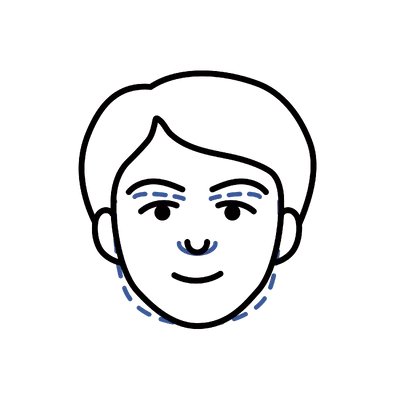
Cheekbone prominence plays a significant role in how gender is perceived. Higher, fuller cheekbones with soft anterior projection are associated with a feminine face, while flatter cheeks with sharper lateral definition read as masculine. Cheek augmentation adds volume and projection to the malar region, bringing the midface into balance with the forehead, nose, and jaw — particularly powerful when combined with other gender-affirming facial work.
Request a Free Quote
Receive Your Plan
We Handle the Rest
Request a Free Quote
Receive Your Plan
We Handle the Rest
Free, no-obligation — you pay the hospital directly with no markup.
What Is Cheek Augmentation?
Cheek augmentation enhances the malar region to improve midface volume, projection, and definition. The midface is a key gender marker: higher, more prominent cheekbones with softer contours read as feminine, while flatter cheeks with a sharper zygomatic arch read as masculine. Augmentation is achieved with solid implants, fat grafting, or a combination of both — depending on the degree of change needed and the patient's goals.
For transfeminine patients, the goal is typically anterior and medial projection — building volume on the front face of the cheekbone for a fuller, rounder midface. For transmasculine patients, lateral augmentation along the zygomatic arch can sharpen and widen the midface. The approach integrates with whatever else is happening to the face — forehead work, jaw contouring, rhinoplasty — so the proportions balance.
Common Concerns Cheek Augmentation Can Address
- Flat or underdeveloped cheekbones lacking projection and definition
- Midface hollowness creating a gaunt or drawn appearance
- Cheek contour that feels mismatched with feminized or masculinized upper and lower face
- Facial asymmetry concentrated in the midface region
Are You a Good Candidate?
- Trans or gender-diverse individuals seeking enhanced midface volume and definition
- In good general health with stable facial soft-tissue volume
- Non-smoker or willing to quit before surgery
Why Choose Thailand for Cheek Augmentation?
Cheek augmentation is technically straightforward but requires an understanding of how midface volume interacts with the rest of the face — particularly in the context of gender transition. Thailand's surgeons and facilities offer both at competitive cost.
Proportional Thinking
Gender-Affirming Midface Specialists
Our partner surgeons plan cheek augmentation in the context of your full facial goals, not as an isolated midface procedure.
40–60%
Genuine Cost Savings
Same implant materials, same surgical techniques, same facility standards. The savings come from Thailand's operating costs, not from shortcuts.
Quick Access
Surgery Within Weeks
No extended waitlists. Standalone cheek augmentation can be scheduled within weeks. Combined FFS plans are coordinated around your availability.
Supported
Full Coordination
Your coordinator handles scheduling, imaging, follow-ups, and any logistics. One point of contact from first enquiry to departure clearance.
Cheek Augmentation Cost in Thailand
We do not charge for our service — you pay the hospital directly with no markup. Here is what cheek augmentation typically costs and what drives the price.
🇹🇭 Thailand
$2,500 – $5,500 (฿88,000–฿193,000)
🇺🇸 United States
$7,500 – $13,800
🇦🇺 Australia
A$7,000 – A$12,500
🇬🇧 United Kingdom
£6,300 – £11,300
Your Quote Will Include
- Board-certified surgeon fee
- Anaesthesia & operating theatre
- Clinic or facility fees
- Post-operative medications
- Follow-up appointments
- Dedicated care coordinator
Prices are approximate and vary by technique, surgeon, and hospital. Your personalised quote will include a full cost breakdown.
Our service is free — you pay the hospital directly with no markup or hidden fees.
Get Your Free Quote
24hr Response
No Obligation
Care Coordinator
Average Cost of Cheek Augmentation in Thailand
Cheek augmentation in Thailand typically costs between $2,500 and $4,500, depending on whether standard implants, fat transfer, or custom 3D-printed implants are used. Standard implant cases sit at the lower end. Custom implants and combination approaches cost more due to additional design, imaging, and fabrication.
Cost Breakdown
The total includes surgeon fees, anaesthesia, clinic or hospital fees, implant cost (if applicable), post-operative medications, and follow-up appointments. Fat transfer involves additional time and donor-site processing. Custom 3D-printed implants include CT imaging, digital design, and manufacturing.
What Affects the Price?
The augmentation method is the main factor. Standard off-the-shelf implants are the least expensive. Fat transfer adds liposuction time and processing. Custom implants involve CT scanning, digital design, and manufacturing — all of which add to the total. Whether the procedure is standalone or part of an FFS package also affects where the cost falls.
Cost by Cheek Augmentation Type
Pricing varies by the complexity and scope of the procedure. Typical ranges at our partner hospitals in Thailand:
- Cheek implants (silicone or PEEK): $2,500–$3,200 — permanent augmentation with custom or standard-shaped implants
- Fat transfer to cheeks: $2,800–$3,600 — uses your own harvested fat for a natural-feeling result
- Combined implants and fat grafting: $3,500–$4,500 — implants for projection with fat layered for soft-tissue refinement
Exact pricing is confirmed after your consultation and treatment plan are finalised.
Thailand vs International Price Comparison
Cheek augmentation in Thailand costs 40–60% less than equivalent procedures in the US ($7,500–$13,800), Australia (A$7,000–A$12,500), and UK (£6,300–£11,300). The price difference reflects Thailand's lower operating costs. Implant materials, surgical technique, and aftercare standards are equivalent to leading international practices.
Types of Cheek Augmentation in Thailand
The method of augmentation depends on how much change is needed, whether you are seeking feminization or masculinization, and your preference regarding implant versus natural tissue.
Implant-Based Augmentation
Solid silicone or porous polyethylene (Medpor) implants are placed over the malar bone through concealed incisions. They provide predictable, permanent volume and come in a range of shapes for feminization or masculinization. Custom 3D-printed implants are available for complex or asymmetric cases.
- Predictable, symmetrical augmentation with precise sizing
- Permanent — implants do not resorb or diminish over time
- Range of shapes available for feminizing or masculinizing goals
- Best for: patients wanting significant, lasting cheekbone projection
Fat Transfer Augmentation
Fat is harvested from the body via liposuction, processed, and injected into the malar region. Creates soft, natural-feeling volume and improves skin quality. Some transferred fat is reabsorbed, so the final volume is slightly less than what is injected initially.
- Uses your own tissue — no foreign material involved
- Natural feel and movement with facial expressions
- Skin quality improvement from the regenerative properties of fat cells
- Best for: patients wanting moderate, natural enhancement or who prefer avoiding implants
Custom 3D-Printed Implants
Designed from your own 3D CT scan data for an exact anatomical fit. Manufactured in biocompatible material to match the specific contours of your cheekbone. Particularly valuable for correcting asymmetry or achieving complex augmentation goals that standard implants cannot address.
- Designed from your own imaging for precise anatomical fit
- Ideal for correcting asymmetry or achieving non-standard contour goals
- Permanent and biocompatible
- Best for: complex cases, asymmetry correction, or highly specific augmentation goals
Cheek Augmentation Techniques Used in Thailand
The technique is chosen based on the degree of enhancement, your anatomy, and whether implants, fat, or both are the best fit. Here are the main approaches.
Intraoral Implant Placement
Cheek implants are placed through incisions inside the mouth, between the upper lip and gum. The implant is positioned over the malar bone and secured with a screw or suture to prevent migration. No external scars. This is the most common approach for standard implant-based augmentation.
- Concealed incisions inside the mouth — no external scarring
- Implant secured to bone for stable, permanent positioning
- Direct access to the malar surface for precise placement
- Best for: standard malar augmentation with symmetrical implants
Microdroplet Fat Injection
Purified fat is injected in small droplets throughout the malar region, layered carefully to build volume evenly. The microdroplet technique maximises fat cell survival by ensuring each graft has adequate blood supply contact. Multiple layers create a smooth, natural contour.
- Small droplet placement maximises fat cell survival rate
- Layered injection creates smooth, even volume distribution
- No foreign material — uses your own tissue
- Best for: moderate augmentation where a natural feel is the priority
Lower Eyelid Approach (for Infraorbital Augmentation)
When augmentation needs to extend onto the infraorbital rim — the bone below the eye — implants can be placed through a lower eyelid incision. This approach is useful for patients with under-eye hollowing in addition to flat cheekbones, as it allows the surgeon to address both areas.
- Addresses both cheekbone and under-eye hollowing through one approach
- Incision sits just below the lash line and heals to near-invisibility
- Allows positioning of implants that extend beyond the standard malar area
- Best for: patients with both cheekbone flatness and infraorbital hollowing
Cheek Augmentation Recovery Timeline (Thailand)
Days 1–3
Swelling and tightness in the midface are most pronounced during the first three days. Puffiness may extend to the lower eyelids and upper lip. Bruising is usually mild. Discomfort is managed with prescribed medication. Soft diet recommended if intraoral incisions were used. Your coordinator checks in daily.
Days 4–7
Swelling subsides and the initial cheek enhancement becomes visible. If fat transfer was performed, some volume will diminish over the first few weeks as grafted fat undergoes partial resorption. Intraoral sutures dissolve on their own. Light social activities can resume.
Weeks 2–4
Most visible swelling has resolved and the augmented contour is clearly apparent. Normal activities resume including moderate exercise. Avoid impact to the face and sleeping face-down. Residual firmness around implants is part of the settling process.
Months 2–6
The cheek contour reaches its definitive shape as residual swelling resolves and any transferred fat stabilises. Implants feel increasingly natural as tissue adapts. By three to six months the result is fully settled and permanent.
Permanent
Implants and surviving fat grafts last
Balanced Volume
Enhanced midface contour
3–6 Months
For final results to settle
When Can You Fly After Cheek Augmentation?
Most patients can fly 7–10 days after standalone cheek augmentation, once healing is confirmed at a follow-up appointment. If combined with other FFS procedures, the departure timeline follows the broader recovery plan. Residual swelling during the flight is normal and settles quickly.
When Can You Return to Work and Exercise?
Desk work can resume within a week. Light exercise after 10 days. Avoid activities with risk of facial impact for at least 6 weeks. Sleep on your back for the first 2–3 weeks to protect implant positioning. Intraoral sutures dissolve — no removal appointment needed.
When Will You See Final Results?
The enhanced cheek contour is visible within the first week as initial swelling subsides. If fat transfer was used, expect some volume reduction over 4–6 weeks as a portion of the transferred fat is naturally reabsorbed. By month 3–6, the result is fully settled. Implant results are permanent from the point of placement.
Risks and Safety of Cheek Augmentation
Cheek augmentation has a favourable safety profile. The specific risks depend on whether implants or fat transfer are used and which incision approach is selected.
- Swelling and bruising in the midface (expected and temporary)
- Temporary numbness or tingling of the cheek area
- Implant malposition or asymmetry requiring adjustment
- Infection around implant material (rare at accredited facilities)
- Fat resorption requiring a touch-up session (fat transfer only)
- Temporary lower eyelid stiffness if the eyelid approach is used
- Implant visibility or palpability in patients with thin soft tissue
A detailed assessment of your malar anatomy, soft-tissue thickness, and facial proportions is completed before recommending an augmentation approach. Every risk specific to the technique selected for your plan is discussed, and you have the opportunity to ask questions before confirming.
Is Cheek Augmentation Safe in Thailand?
Yes. Cheek augmentation is a well-established procedure with a low complication rate. At JCI-accredited hospitals with experienced surgeons, the safety profile is comparable to international centres. The implant materials used — medical-grade silicone and porous polyethylene — have decades of clinical track record.
How to Reduce Risks
Choose a surgeon with specific malar augmentation experience. If you are having intraoral incisions, ensure your dental health is good and consider a cleaning beforehand to reduce oral bacteria. Stop smoking before surgery to reduce infection risk around implants. Follow all instructions about sleeping position and diet during recovery to protect implant positioning.
Will Implants Need Replacing?
Cheek implants are designed to be permanent and do not need scheduled replacement. Both silicone and Medpor implants last indefinitely. In the rare event of a complication such as malposition, they can be adjusted or removed. Fat transfer may require a touch-up session if more of the transferred fat is reabsorbed than expected.
Top Cheek Augmentation Surgeons & Clinics in Thailand
Cheek augmentation is relatively straightforward, but implant sizing and placement require good aesthetic judgment — particularly when the goal is gender-affirming. Here is what to look for.
Leading Hospitals and Clinics
Our partner surgeons perform cheek augmentation at both specialist clinics and JCI-accredited hospitals. Standalone cases can be done as day procedures at a clinic. When combined with FFS, the procedure takes place at a full hospital with overnight capacity and craniofacial support infrastructure.
Experienced Cheek Augmentation Surgeons
Our partner surgeons have specific experience in gender-affirming malar augmentation. They understand the different projection vectors for feminization (anterior and medial) versus masculinization (lateral and inferior along the zygomatic arch) and select implant shapes accordingly. Several have trained internationally and bring that perspective to their Bangkok-based practice.
What to Look for in a Surgeon
Ask about their experience with gender-affirming cheek augmentation specifically — standard cosmetic cheek implants may not achieve the same goals. Review before-and-after photos of patients with similar anatomy and transition direction. Confirm they assess cheek augmentation in the context of your overall facial plan rather than treating it as an isolated procedure.
Before and After Results
Cheek augmentation results are permanent (implants) or long-lasting (fat transfer). Here is what to expect.
Typical Results
Feminizing cheek augmentation produces fuller, higher-projecting cheekbones that create a rounder, softer midface. The heart-shaped face contour becomes more pronounced. Masculinizing augmentation adds lateral definition and sharpness along the zygomatic arch. In both cases, the change integrates with the rest of the face — particularly noticeable when combined with jaw and forehead work.
What Results Can You Expect?
The enhanced cheek contour is visible within the first week. If fat transfer was used, the initial volume reduces slightly as some fat is reabsorbed — the stabilised volume is your permanent result. Implants do not change once placed. By month three, the result is fully settled and requires no maintenance.
Planning Your Trip to Thailand for Cheek Augmentation
Standalone cheek augmentation is one of the shorter recovery procedures. Here is how to plan the trip.
How Long to Stay in Thailand
Plan for 7–10 days for standalone cheek augmentation. This covers consultation (day 1), surgery (day 2), a few days of recovery, and a follow-up appointment before departure. If combined with FFS, the stay extends to 14–21 days to match the broader recovery timeline.
What's Included in a Medical Trip
Your coordinator handles scheduling, transfers, and follow-up appointments. The surgical quote covers surgeon fees, anaesthesia, facility fees, implants or fat processing, medications, and aftercare. Flights and accommodation are arranged separately, but your coordinator can recommend nearby options.
Standalone vs Combined Trip
Standalone cheek augmentation has a quick recovery — you can be out exploring Bangkok within a few days. If it is part of an FFS plan, it adds almost nothing to the overall recovery timeline. In either case, your coordinator builds the trip schedule around your specific procedure combination.
Common Questions About Cheek Augmentation
Everything you need to know before your procedure
Seven to ten days for standalone cheek augmentation. This covers consultation, surgery, initial healing, and a follow-up before departure. If combined with FFS, plan for 14–21 days.
Both work. Implants provide predictable, permanent volume and are best for significant projection. Fat transfer creates a softer, more subtle result and avoids foreign material, but some transferred fat is reabsorbed. The choice depends on your anatomy, the degree of change needed, and your preference.
Intraoral incisions leave no external scars. If a lower eyelid approach is used, the incision sits just below the lash line and heals to an essentially invisible line. Fat transfer involves only tiny puncture marks at the injection sites.
The procedure is under general anaesthesia or local with sedation — you feel nothing during surgery. Afterward, most patients describe moderate tightness and soreness in the midface, similar to the feeling after dental work. It subsides within a few days.
Most patients fly 7–10 days after standalone cheek augmentation, once healing is confirmed at a follow-up.
Your quote covers surgeon fees, anaesthesia, facility fees, implant or fat processing costs, post-operative medications, follow-up appointments, and a dedicated care coordinator. Custom 3D-printed implants are quoted separately. Flights and accommodation are not included.
Cheek implants are permanent. Both silicone and Medpor implants are designed to last a lifetime and do not require replacement. In the rare event of a complication, they can be adjusted or removed.
Yes — it is commonly performed alongside forehead contouring, rhinoplasty, and jaw reshaping as part of FFS. Adding cheeks to the session allows the surgeon to balance midface volume against the changes happening above and below.
When properly sized and placed, cheek implants sit on the bone beneath the soft tissue and are not visible or palpable. Fat transfer produces an inherently natural feel because it uses your own tissue. In both cases, the augmentation should look and feel like a natural part of your face.
Stop blood-thinning medications and supplements at least two weeks before surgery. Quit smoking a minimum of three weeks prior to reduce infection risk around implants. If intraoral incisions are planned, ensure your dental health is good and consider a cleaning beforehand. Prepare soft foods for the first week of recovery.
NP
Nick Peplow
REVIEWED BY
Patient Care Director
Last reviewed: March 25, 2026
Medical disclaimer: Content on this site is provided for informational purposes and should not be treated as medical advice. Outcomes, timelines, and eligibility differ from person to person. Speak with an experienced gender-affirming surgeon before proceeding with any procedure.